
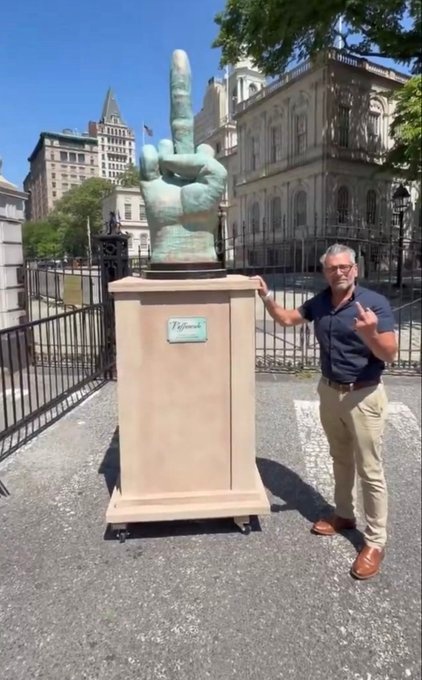
A giant gesture can say a lot in New York politics. Scott LoBaido’s latest installation made sure nobody could miss the message.
A Provocative Display Lands at City Hall
Artist Scott LoBaido installed a towering middle finger statue directly outside New York City Hall, aiming the work squarely at Mayor Zohran Mamdani and the progressive politics he represents. The piece appeared in lower Manhattan in the afternoon and immediately drew attention from passersby, cameras, and social media users. Images of the installation spread rapidly, turning a local political stunt into a citywide flashpoint within hours.
LoBaido is not an unknown provocateur parachuting into public life for a quick headline. He is a New York-based artist and performance activist with a long record of staging confrontational public displays tied to immigration, policing, urban policy, and cultural identity. His work often blends patriotic imagery with blunt symbolism, and this latest statue followed that same formula by using spectacle to deliver an unmistakable insult.
The target this time was Mamdani, the democratic socialist who was sworn in as mayor on January 1, 2026, becoming the city’s youngest mayor in more than a century. LoBaido framed the sculpture as a protest against Mamdani’s leadership and against what he sees as the growing power of progressive politics in New York. Video from the scene showed the installation facing City Hall as onlookers gathered around it, underscoring how effectively the artist turned a patch of civic space into a stage.
Why the Installation Resonated So Quickly
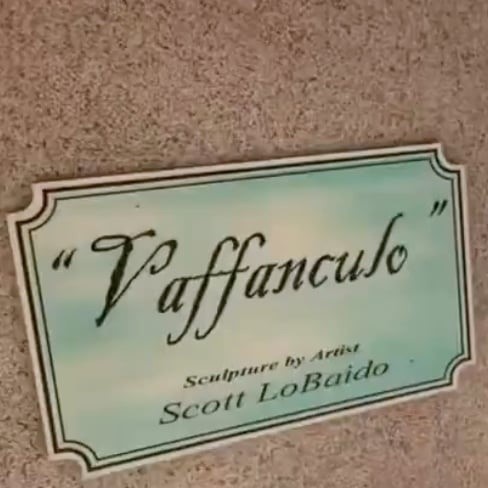
The installation went viral because it fused three elements that dominate modern political media: visual shock, a high-profile target, and an already polarized public. A giant obscene gesture requires no explanation, and in a city as politically divided as New York, viewers immediately understood it as a referendum on Mamdani as much as a personal attack. That instant readability gave the piece unusual power in the attention economy.
Its timing also mattered. Mamdani has become one of the most closely watched progressive figures in urban politics, and his rise has energized supporters while unsettling critics who see his agenda as too ideological. That made LoBaido’s statue more than a prank or publicity bid; it became a cultural marker in the broader fight over what kind of city New York should be.
There is also a historical echo to the backlash. Mamdani previously faced criticism over a 2020 post in which he gestured mockingly toward a Christopher Columbus statue in Queens and wrote, “Take it down.” That episode angered many Italian-American groups and remained part of the political conversation during his mayoral run. LoBaido’s installation tapped into that unresolved symbolism, using insult, monument imagery, and public memory to sharpen an old grievance into a new confrontation.
Protest Art, Political Theater, and What Comes Next
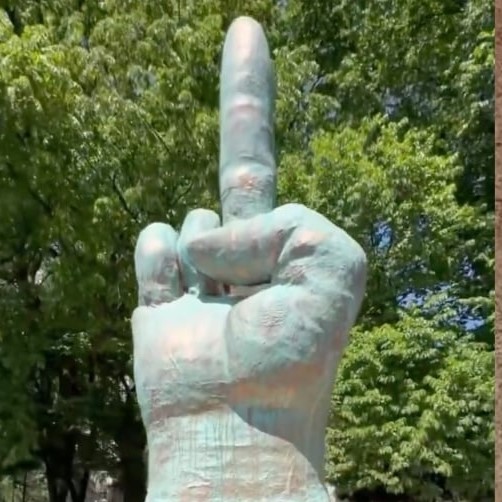
Political installations have become a recurring feature of America’s culture wars, and LoBaido’s statue fits squarely within that trend. Across the country, artists and activists have used oversized props, mock monuments, and deliberately offensive visuals to attack public figures from every direction. These works thrive because they collapse activism, performance, and media strategy into a single moment that can be photographed, clipped, and endlessly reposted.
LoBaido has repeatedly used this approach in New York. He previously protested congestion pricing by mounting a vehicle and displaying a large middle-finger sign near Columbus Circle, an action that reportedly led to his arrest in January 2025. He has also protested city food regulations by throwing pizzas over the gates of City Hall, demonstrating a pattern of theatrical dissent aimed at highly visible institutions.
Whether viewers see the latest statue as protected expression, vulgar intimidation, or savvy street theater, it succeeded on its own terms by forcing a reaction. It put Mamdani, City Hall, and the city’s ideological divide into one image that was impossible to ignore. In a political era shaped by symbolism as much as policy, that may be the real point: not persuasion, but confrontation in its most public form.